



The digital world we live in today filled with laptops, smartphones, and supercomputers—had its beginnings long before modern technology took shape. The idea of a machine that could perform calculations faster and more accurately than humans dates back centuries. While many early devices contributed to computing history, the world’s first true programmable computer is widely recognized as the ENIAC (Electronic Numerical Integrator and Computer), completed in 1945. However, the journey toward this groundbreaking invention began even earlier, with mechanical prototypes and visionary ideas that laid the foundation for modern computing.
The earliest known computing device is the Abacus, used thousands of years ago for basic arithmetic. Fast forward to the 19th century, and the world saw a revolutionary concept introduced by Charles Babbage, often called the “Father of the Computer.” Babbage designed the Analytical Engine, a fully mechanical general-purpose computer. Although it was never completed due to technological limitations of the time, it featured elements still used in today’s computers: a processor, memory, and the ability to follow instructions. Ada Lovelace, a mathematician, wrote the first algorithm for this machine, making her the world’s first computer programmer.
The real transformation began during World War II, when the need for rapid calculations became crucial. In 1943, British engineers developed Colossus, an early electronic computer used to break enemy codes. Colossus was a major achievement, but it was not fully programmable in the modern sense. This paved the way for an even greater milestone ENIAC, the world’s first general-purpose electronic computer.
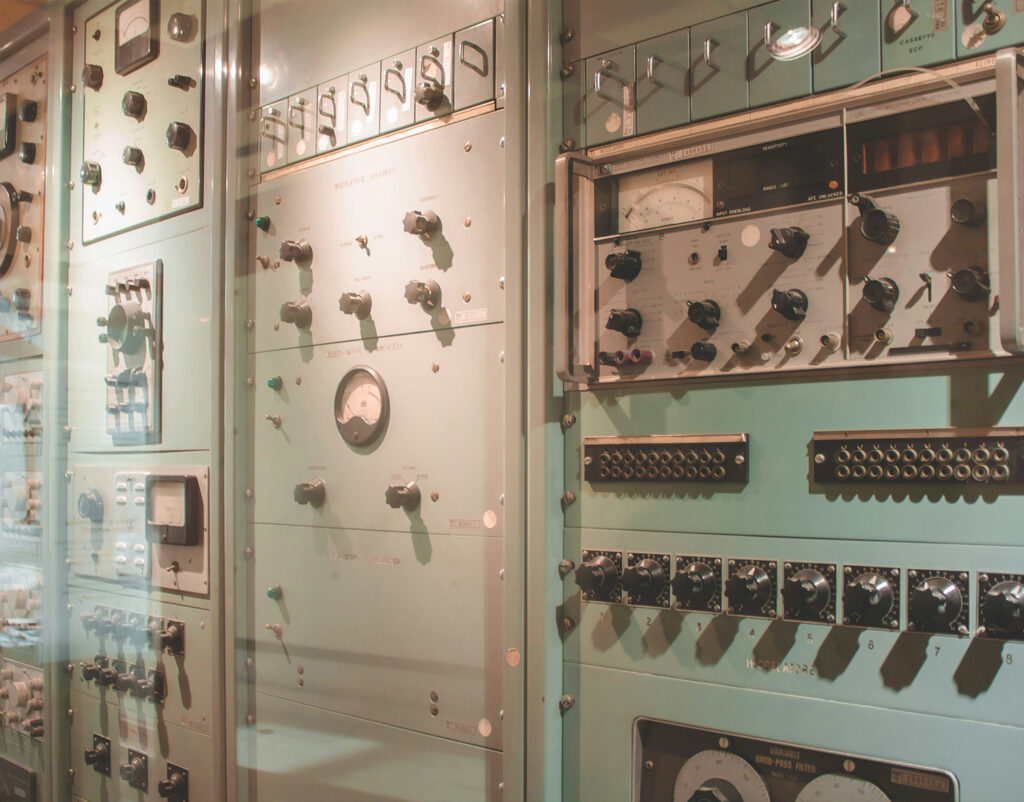
Completed in 1945 by John Presper Eckert and John Mauchly at the University of Pennsylvania, ENIAC was a technological giant. It weighed nearly 30 tons, covered 1,800 square feet, and consumed as much power as a small town. Instead of mechanical parts, ENIAC used 18,000 vacuum tubes, making it hundreds of times faster than previous machines. It could perform complex calculations in seconds, a task that would take humans days or even weeks.
ENIAC’s primary purpose was to calculate artillery firing tables for the U.S. Army. However, it soon proved capable of solving a wide range of mathematical problems—from weather prediction to atomic energy research. Programming ENIAC was a monumental task, requiring users to manually plug in cables and adjust switches. Despite this, it represented a massive leap forward in computational technology.
The invention of ENIAC set off a chain reaction in the world of technology. It led to the development of transistors, integrated circuits, microprocessors, and eventually the modern computers that fit in our pockets today. What was once a room-sized machine has now evolved into lightweight devices capable of performing billions of operations per second.
The world’s first computer was more than a machine it was the spark that ignited the digital revolution. It changed how we work, communicate, learn, and interact with the world. From Babbage’s mechanical dreams to ENIAC’s electronic reality, the journey of the first computer is a reminder of human innovation and the endless possibilities technology continues to unlock.